
I’ve lost count of how many times a client has sat down, looked in the mirror, and started the session with an apology.
“Sorry, my skin is a mess right now.”
“Sorry, I broke out before the wedding.”
“Sorry, I didn’t sleep.”
“Sorry, this is just what it looks like without filters.”
I need you to know that I do not need the apology. I have never needed it.
Your skin is the reason I have a job. Not the perfected version. The actual one—the one with texture, redness, a scar from years ago, the patch that gets dry when the seasons change, the under-eyes that show when you’ve been carrying too much. I have worked on hundreds of faces. Not one of them was a blank canvas, and not one of them needed to apologize for existing in its current state before I picked up a brush.
What I actually see
When you apologize, I hear that you have been taught to treat your face as a problem to be solved before anyone else is allowed to look at it. I understand where that comes from. The entire industry is built on the idea that something is missing or wrong until product intervenes. But that is not how I was trained, and it is not how I work.
I see the structure of your face. I see where light hits and where it falls away. I see what is temporary and what is permanent. I see what will photograph and what will settle by afternoon. None of that starts with judgment. It starts with information. Your skin is giving me the information I need to do my job well. An apology does not add anything useful to that process.

The wedding-day version
Brides apologize more than anyone. The stakes feel higher, the mirror feels crueler, and there is often a long history of being told that this particular day requires a different face. I have held the hands of women who were close to tears because a breakout appeared three days before the ceremony. I have also watched those same faces, once we got to work, become calm again—not because I erased every mark, but because we stopped treating every mark as a crisis.
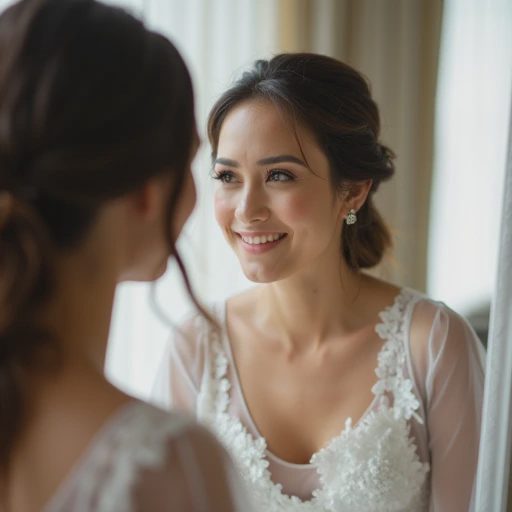
You are allowed to want your skin to look even. You are allowed to want coverage, or brightness, or a finish that makes you feel more like yourself. Wanting those things is not the same as owing an apology for the starting point. The starting point is simply where we begin.
What I want you to do instead
Sit down. Look at me, or look at the mirror, and tell me what you want the result to feel like. Tell me what bothers you and what you do not mind. Tell me if you have been picking at something or if you are exhausted or if you are just tired of performing perfection before the real work starts. That information helps. The sorry does not.
I will still color-correct. I will still even out what you want evened out. I will still make the decisions that help your face hold up for the hours ahead. I will do all of it without needing you to be sorry that your skin is human.
The only standard that matters
If I wouldn’t put a product or a technique on a bride, I will not recommend it to you. That rule exists to protect your face from trends, from marketing, and from my own ego. It does not exist to enforce a single definition of flawless. Flawless has never been the assignment. Looking like yourself under the conditions of the day—that is the assignment.
Your skin does not have to earn the right to be seen by first becoming something else. It only has to show up. I can work with that. I prefer to work with that.
So the next time you sit in someone’s chair and feel the apology rising, you can keep it. Or you can say it and then let it go. Either way, know that the person on the other side of the brush has seen it all before and is not collecting penance for pores.
You were never required to be perfect before you were allowed to be done.
Signed,
Your makeup artist
If I wouldn’t put it on a bride, I won’t tell you to put it on your face.
And I would never ask a bride—or anyone else—to apologize for the skin she arrived with.




No notes yet — write the first one.