
If you find your foundation shade by swiping three bottles across your wrist and choosing the one that disappears, we need to talk. That skin is not the same color as your face, and indoor store lighting has lied to better-prepared people than either of us. After matching more than 200 faces for weddings, shoots, and long event days, I can tell you that the reliable way to find your foundation shade is a short process: identify your depth, work out your undertone, test on the face, and let the formula sit.
Start with skin depth, not undertone
Skin depth means how light or deep your complexion appears overall. Undertone describes the color underneath that surface: warm, cool, neutral, or olive. They are separate decisions. Someone can have light skin with a golden undertone, medium skin with a pink undertone, or deep skin with a neutral undertone.
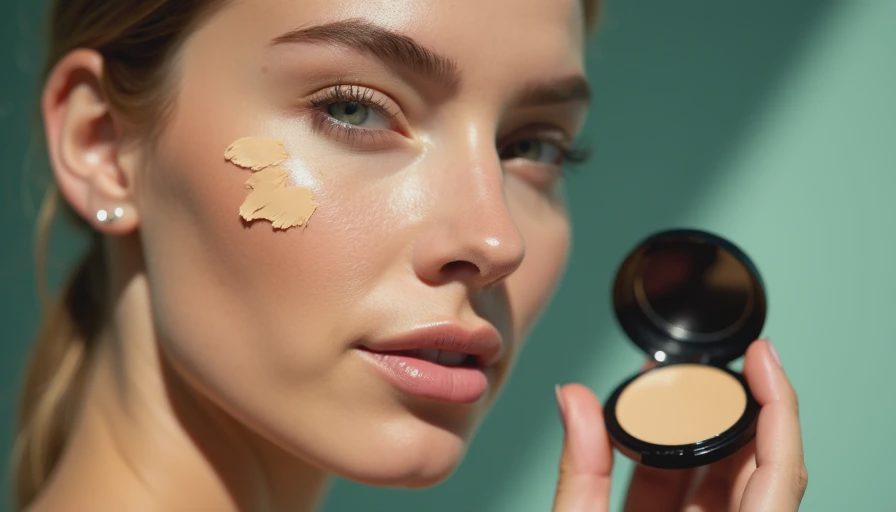
Begin with five or six shades in the same formula. Do not compare a full-coverage matte foundation with a sheer serum tint and assume the color difference is the only variable. Apply narrow vertical stripes from the middle of your cheek down toward your jaw. The best shade should visually connect your face, jaw, and neck. Your hand is useful for checking texture, but it is a terrible final color-matching tool.
If every available shade looks too pink, too orange, or oddly gray, the problem may be the brand's range rather than your skin. Try another line instead of forcing a bad match. NARS Light Reflecting Foundation, Estée Lauder Double Wear, Maybelline Fit Me Matte + Poreless, and L'Oréal True Match all organize shades differently, so a label such as medium beige will not mean the same thing across bottles.
Use veins as a clue, not a verdict
The classic vein test is helpful but not conclusive. Blue or purple-looking veins can suggest a cool undertone, green veins can suggest warm, and a mix can point toward neutral. Olive skin often makes this test confusing because it can look green, gray, yellow, or even slightly pink depending on the light. That is why I never find your foundation shade from veins alone.
Look at the areas that do not flush easily: your jaw, upper chest, and the inside of your forearm. Warm undertones often look golden, yellow, or peach. Cool undertones can read pink, rosy, or red. Neutral skin sits between those descriptions. Olive skin usually needs a muted green-gold base rather than a strongly yellow or pink one; a conventional warm shade can turn orange within minutes.
Jewelry is another soft clue. If gold looks more harmonious, warm may be in the picture; if silver looks cleaner, cool may be closer. But makeup is not a personality quiz. If the tests disagree, trust a face swatch in daylight over a bracelet or a social media chart.
The correct way to test a shade
Apply your finalists to clean, moisturized skin after your normal sunscreen has settled for about ten minutes. Use a small amount and spread each stripe thinly. Foundation can dry down darker, especially formulas with a high pigment load, so wait at least five minutes before judging. If you find your foundation shade immediately under bright retail bulbs, you are skipping the part where the product actually changes.
Step outside or stand beside a large window. Check the swatches from arm's length and in a mirror, not with your nose six inches from your cheek. The right match should become difficult to see at normal conversational distance. Do not test on a red blemish, fresh sunburn, or area with heavy discoloration; those spots distort the comparison.
For a wedding or a full workday, wear the closest two shades for several hours. Take a photo in daylight, then inspect the color after four and eight hours. A shade that looks perfect at application but turns orange by lunch is not a match. If you find your foundation shade this way, you are also testing oxidation, oil breakthrough, and how the formula behaves over your actual skincare.

Match the neck, but respect the face
The goal is not to erase every difference between your face and body. Sunscreen, acne marks, rosacea, and natural flushing can make the face slightly different from the neck. A foundation that matches the neck perfectly can look too pale on a face with more surface redness. I usually choose the shade that creates the most believable bridge between jaw and neck, then use concealer only where extra coverage is needed.
For bridal makeup, I often use a thin, well-matched layer across the face and add coverage around the nose, chin, or eyes. This photographs better than applying a much lighter foundation everywhere. In person, an overly pale base looks like a mask; in flash photography, a heavy layer can emphasize texture and dryness.
If your face is darker than your neck after a summer outdoors, do not automatically buy a new bottle. A few drops of a deeper liquid mixer can adjust an existing shade, while a lighter concealer can brighten the center of the face. That approach is especially useful when your winter and summer colors are only half a shade apart.
Picking a formula after the color is right
Shade is only half the match. Dry skin usually looks more comfortable in a hydrating liquid or satin finish, while very oily skin often needs a longer-wearing formula and controlled powder through the T-zone. Normal or combination skin has the widest range of options. A beautiful color in the wrong finish can still separate, cling, or disappear before dinner.
At the drugstore, Maybelline Fit Me and L'Oréal True Match are practical places to start, with many shades priced around $10 to $15. Midrange options such as Fenty Beauty Pro Filt'r and Make Up For Ever HD Skin typically offer broader undertone choices, often around $40 to $45. Estée Lauder Double Wear remains a strong choice for formal events when you want a set, long-wearing finish, but apply it in thin layers rather than one thick coat.
I have worn-test foundations for full workdays, and the shade that survives a twelve-hour wedding is rarely the one applied with a heavy hand. Preparation, a damp sponge or clean brush, and a light layer matter as much as the label on the bottle.
What to do when your match is between shades
Being between shades is normal, especially when a brand skips your undertone. First, test whether one shade blends invisibly after five minutes. If both are close, the deeper shade often works around the perimeter while the lighter shade brightens the center, but only when the undertones are compatible. Mixing two shades is also practical; use a clean palette and record the ratio so you can repeat it.
Do not add white concealer to rescue a foundation that is too orange or pink. That changes depth without correcting undertone and can leave the complexion chalky. Instead, return to the shade family and look for a more neutral or olive option. A tiny amount of blue or yellow mixer can correct a professional kit, but beginners are better served by finding a closer bottle.
If you still cannot find your foundation shade, visit a counter with clean skin and ask for two face swatches, not a hand sample. Bring your usual sunscreen and photograph the result near a window. The best match is the one that looks like skin before, during, and after a normal day. If I would not put it on a bride, I will not tell you to put it on your face.




No notes yet — write the first one.